

Luther taught that the purpose of every vocation—in the workplace, the family, the state, and the church—is to love and serve your neighbors, specifically, the neighbors whom your callings bring into your life. When workers love and serve their customers, spouses love and serve each other, rulers love and serve their citizens, pastors love and serve their flock, God’s love is active through them.
In that context, Luther wrote about tools:
If you are a manual laborer, you find that the Bible has been put into your workshop, into your hand, into your heart. It teaches and preaches how you should treat your neighbor. Just look at your tools—at your needle or thimble, your beer barrel, your goods, your scales or yardstick or measure—and you will read this statement inscribed on them. Everywhere you look, it stares at you. Nothing that you handle every day is so tiny that it does not continually tell you this, if you will only listen. . . . All this is continually crying out to you: “Friend, use me in your relations with your neighbor just as you would want your neighbor to use his property in his relations with you.”[i]
For Luther, tools are implements for loving your neighbor. Tools—thimbles, scales, beer barrels—are technologies.
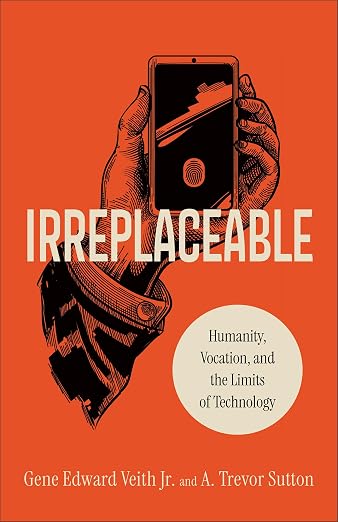
Trevor Sutton is a pastor who recently earned his doctorate from Concordia Seminary and wrote his dissertation on technology and the church. He and I have just published a book entitled “Irreplaceable: Humanity, Vocation, and the Limits of Technology.”[ii] We discuss the whole gamut of technologies—bows and arrows, factories, automobiles, television, computers—showing how they can be both tools of blessing and tools of sin, always applying Luther’s dictum of how they might be used vocationally; that is, in love and service to our neighbors.
Here I would like to treat briefly what we treat extensively in our book, a technology that today seems to directly challenge the very concept of vocation: Artificial Intelligence.
It is easy to see how needles, yardsticks, and beer barrels can “teach and preach how you should treat your neighbor.” But can AI teach and preach that? Can we use AI to love and serve our neighbors?
Yes. AI can quickly gather and sort out complex information, giving us more time for our neighbors. Workers can use AI to become more productive, thus multiplying the goods and services that they provide their customers.
But AI is different from other tools in that it also purports to replace human beings in their vocations. In the workplace, where automation has long been displacing blue-collar workers, AI threatens to take over the jobs of computer programmers, journalists, teachers, managers, and other white-collar professionals.
More than that, AI chatbots are replacing human relationships, as people turn to them for friendship, counseling, even romance. And AI chatbots are taking over distinctly human powers: thinking, creating, expressing.
A pastor can ask AI to write his sermon for him. Give the chatbot a lectionary reading and tell it to generate a Lutheran sermon, and it will do so in seconds. The sermon will likely give a thorough exegesis of the biblical text, drawing on multiple Lutheran commentaries, and make a proper distinction between law and gospel.
Should a pastor use AI to write his sermon, which could free him up for person-to-person ministry? No. Why not? Because the pastor has a calling from God to preach his word. AI does not.
A pastor might use AI for research and tracking down information. But God has called the pastor—not AI—to preach, catechize, and give pastoral care to his people. God promises to work through the pastor’s vocation, but AI has no such promise.
AI does not have a vocation. Only human beings do. We can use AI to serve our vocations, but we must not let it usurp our vocations.
The vocation of a student involves studying, learning, and cultivating the mind. Not using AI to do the homework, summarize the readings, and write the papers. Journalists should write, not just input prompts and let AI write their stories. Managers should interact with their employees, not turn them over to the supervision of a machine.
Just as God blesses our neighbors by means of our vocations, we are blessed when God works through our neighbors’ vocations. Just as we must not let AI replace us in our vocations, we must not turn to AI when we need to be loved and served by a human being.
AI should not be used as a girlfriend or boyfriend. Or as a counselor, a doctor, or lawyer. Or as a pastor.
Or as an author. A study found that 63% of the religion books on Amazon were likely written by AI.[iii] AI-written fiction has won literary prizes[iv] and scored big publishing deals—until the scam is detected.[v] Then the prize, the publishing contract, and the readership are taken away.
Or as a musician. Of the new music uploaded every day on the music stream service Deezer, 44% is AI generated. But though some AI music hits the chart and some AI-generated musical acts have gotten record deals, when the fakery is discovered, the public stops listening. Spotify says that despite its own similar rate of AI uploads, only 1% of its subscribers listen to it. [vi]
The publishing, music, and other creative industries are organizing to keep out AI-generated work. And human beings hate it. This is because what we treasure in art is the expression and creation of a fellow human being with whom we are connecting. This is vocation in God’s design.

[i]Martin Luther, “Commentary on the Sermon on the Mount” in Luther’s Works (Concordia Publishing House, 2007), 21:237.
[ii] Gene Edward Veith and A. Trevor Sutton, Irreplaceable: Humanity, Vocation, and the Limits of Technology (Baker Books, 2026).
[iii] Jason Nelson, “63% of Religious Books on Amazon Are Likely AI-Written, Study Finds” Yahoo! Tech, 23 August 2026.
[iv] Vincenzo Barney, “AI has ruined literary prizes” Unherd, 4 July 2026.
[v] Jeffrey A. Trachtenberg, “Publisher Pulls ‘Shy Girl’ Horror Novel After AI Allegations” Wall Street Journal, 19 March 2026.
[vi] Lena Brandt, “AI Music Statistics: 44% of New Tracks Are AI-Generated” Custom Songwriter, 28 May 2026.
Leave a Reply
You must be logged in to post a comment.