
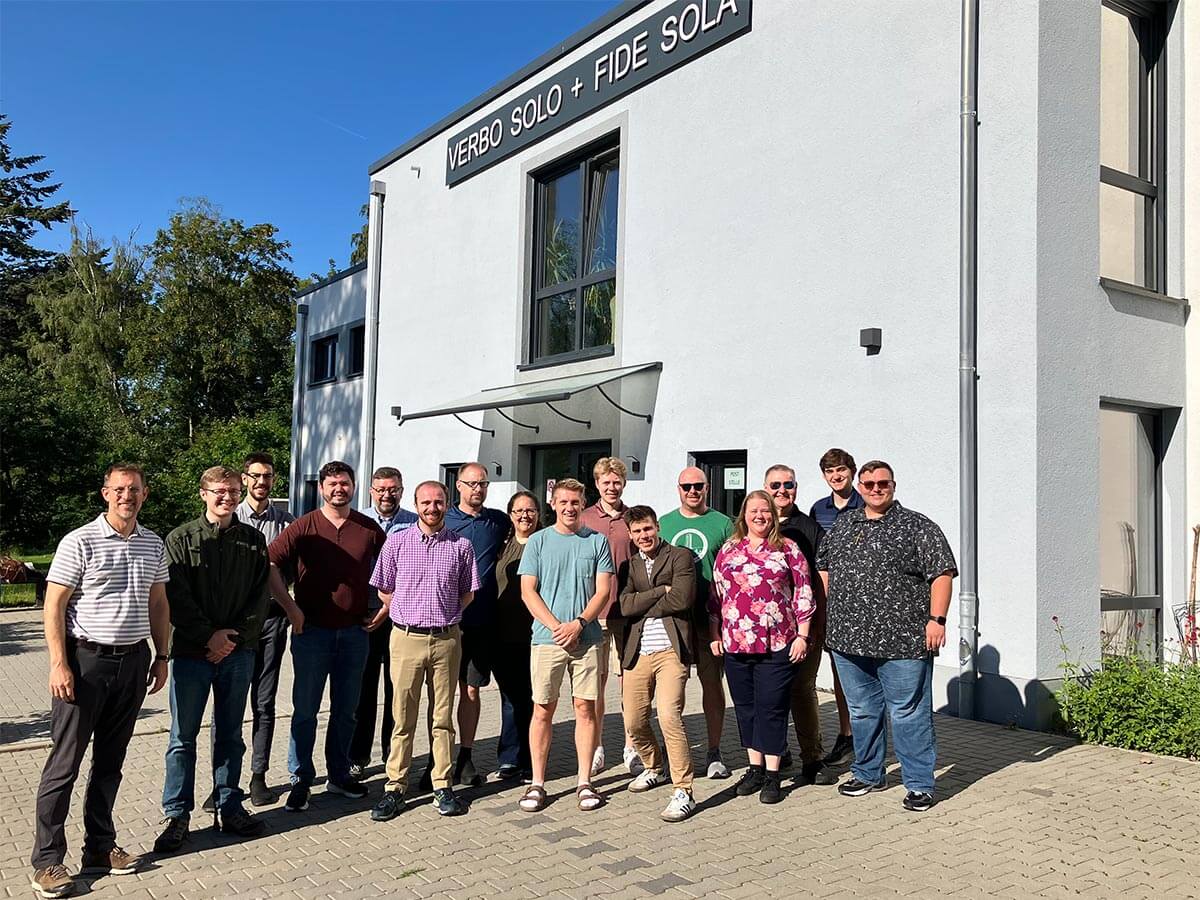
Concordia Seminary recently added a new course to its curriculum. It was held for the first time May 18 – June 2, 2026. In terms of enrollment, it was at capacity. In terms of the catalogue, it was listed as a course in historical theology. But like any good history class (and any good seminary class) it was also thoroughly practical. The course was called “Luther as Preacher of the Reformation.”
Several things made it unique.
- It was offered on location in Germany. Twelve students (plus two spouses) and two professors visited towns, sanctuaries, and even a few of the pulpits where Luther preached.
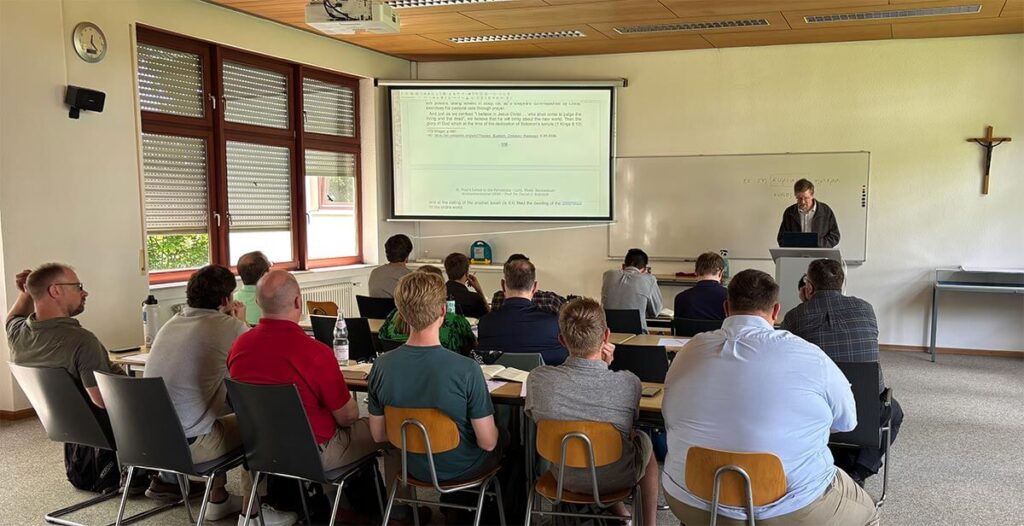
- Besides a few secondary studies and guided tours, the class devoted most of its time and attention to reading and discussing Luther’s own sermons.
- The course was team-taught by a professor who teaches history and a professor who teaches homiletics. They explored the context and impact of the sermons in their original context, as well as insights and implications for gospel proclamation today.
- Students built meaningful connections with fellow Lutherans in Germany who, like us, are striving to be faithful in a challenging secular and pluralistic society.
During the concluding dinner, we spent time reflecting on the course. Students shared what they learned about Luther, what they heard in his preaching, and how this experience will impact their ministries going forward. Here are some of the highlights we discussed.
Hospitality
Some Americans have heard the German word gemütlich. It means “cozy,” “friendly,” or “comfortable.” It’s a good word (even if it doesn’t appear in the Bible). Not as many are familiar with the German word gastfreundlich. This word means “hospitable.” The New Testament uses this word repeatedly to exhort Christians and pastors to practice love toward strangers. Based on our experience in this course, our sister church body (the SELK, or Independent Lutheran Church of Germany) has been reading their Bibles.
We began the trip with a stay at our sister seminary Die Lutherische Theologische Hochschule and its next-door congregation St. Johannes-Gemeinde (photo above).
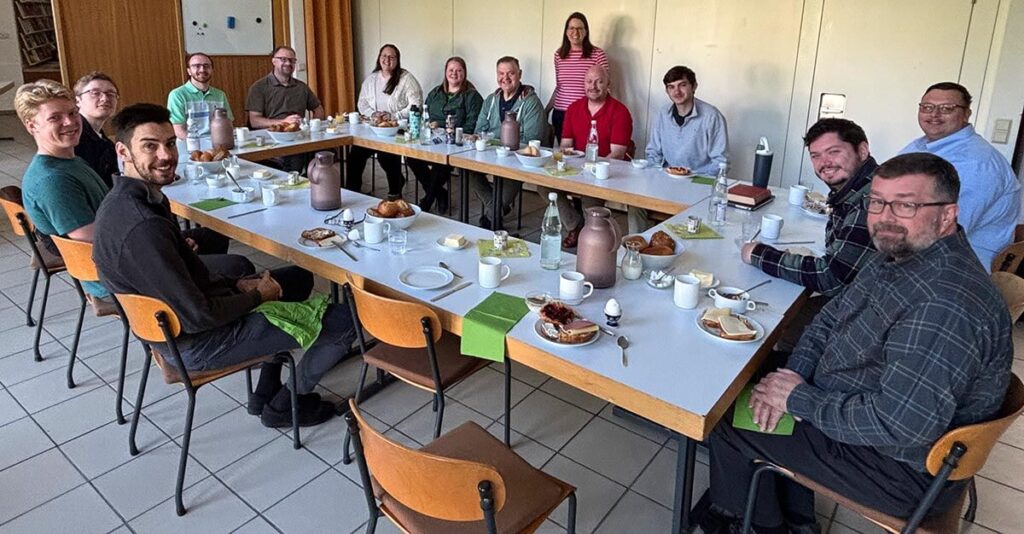
In Oberursel, our brothers and sisters shared their homes, their hearts, their classrooms, their grill, and their brass choir. Our days on campus were filled with hearty German breakfasts, substantive theological conversation, and an opportunity to gather together for worship.
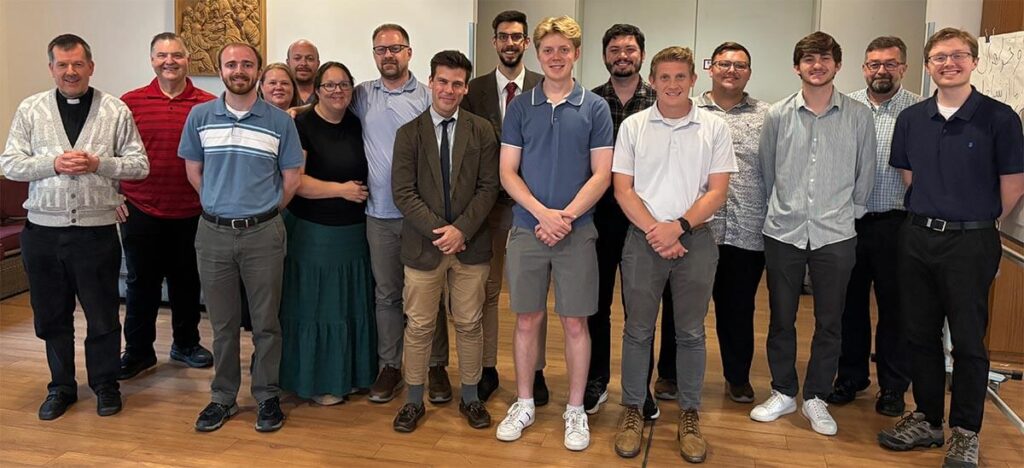
Later in the trip, we were welcomed to a traditional German worship service and a congregational meal at Christuskirche in Erfurt, as well as a lively Farsi-speaking worship service and lunch at Dreieinigkeits-Gemeinde in Berlin. In each case, we experienced firsthand as foreigners what it means to receive the love of Christ in tangible ways.
Luther’s Preaching
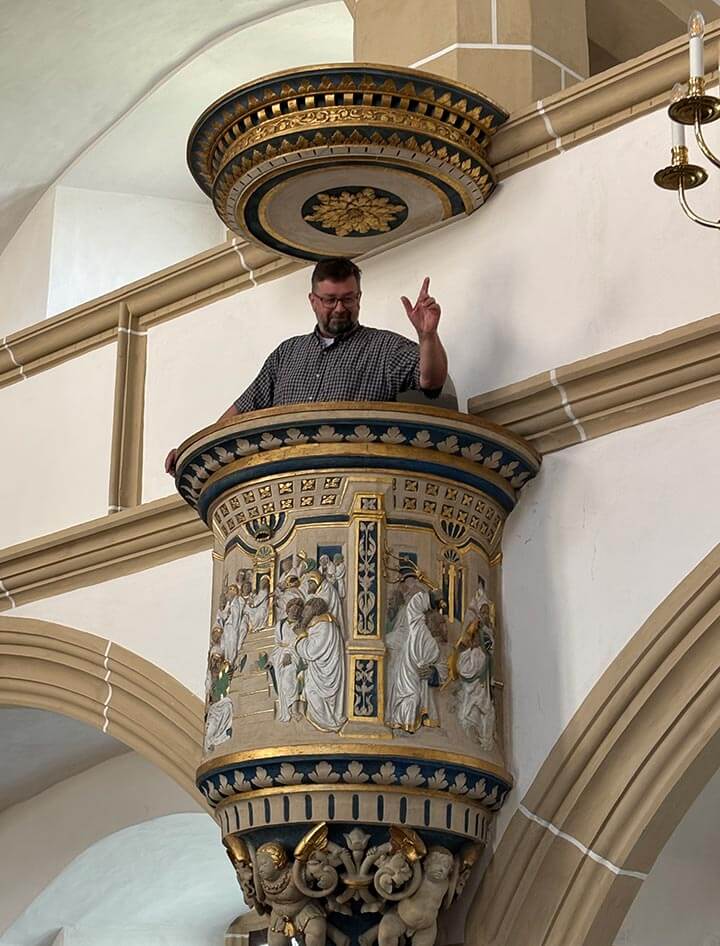
During the course of his ministry, Luther is estimated to have preached somewhere around 4000 sermons. We didn’t read them all. Instead, we selected thirty-six. We read his first sermon and his last sermon. We read his sermon on law and gospel and his sermon on the sum of the Christian life. We read sermons on the resurrection of Jesus, sermons on suffering and the cross, wedding and funeral sermons, catechetical and ordination sermons. We even read the sermon Luther preached at the dedication of the first Lutheran sanctuary.
As we immersed ourselves in Luther’s preaching, we noticed a number of recurring themes:
The Word of God
Over and over, Luther emphasized the Word of God—especially the biblical gospel of Jesus Christ. Through the Word alone God deals mercifully with us, and it is the Word alone that we proclaim.
In an ordination sermon in 1535, Luther compared the preacher to a diseased hand and the gospel to a gold coin. “Our preaching of salvation to men does not stem from our power [nor] the emperor’s. We are merely an instrument and means, through which Christ is speaking and which He is using to raise you up. [This is] like a lord [who] places a gold coin in the hand of [his] servant so that [he would give it] to a needy person . . . Even if a parish pastor is neither righteous nor worthy to [be called] God’s son and servant—so, too, the servant, even if his hand is bad and scurfy—nevertheless the gold coin, which the lord is giving by means of his hand, is good, because it is the lord’s own.”
In a sermon for the dedication of the first Lutheran sanctuary at Torgau Castle in 1544, Luther emphasized the centrality of the preached Word in worship: “The purpose of this new house may be such that nothing else may ever happen in it except that our dear Lord himself may speak to us through his holy Word and we respond to him through prayer and praise.” We are not bound to worship in any particular time or place, Luther insisted, for “we are all priests, as is written in 1 Pet. 2, so that all of us should proclaim God’s Word and works at every time and in every place.” Still, it is a good to “come together at a time and place which we are agreed upon, deal with and listen to God’s Word, bring to God our ordinary and unusual needs and those of others and thus launch up to heaven a strong, effectual prayer, and also together laud and praise God’s goodness with thanksgiving.”
In a sermon on John 20 in 1531 (published in 1544), Luther emphasized the ministry of the Word in contrast to a prominent false teaching of his day: “Therefore, let us note carefully that Christ sets the forgiveness of sins here in his Word, and not in pilgrimage, Masses, alms, or other works, whatever they may be called. So now if anyone desires forgiveness of sins, let him go to his pastor or to the nearest Christian, with whom he knows he can find God’s Word; there he will certainly also find the forgiveness of sins.”
Jesus’s Death and Resurrection
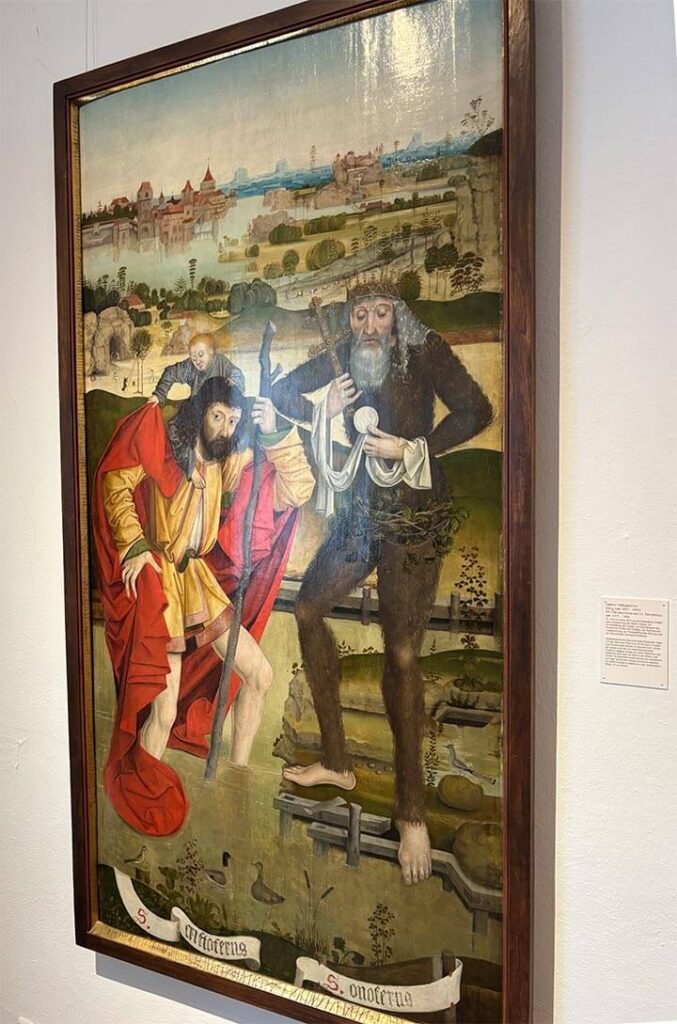
Unsurprisingly, Jesus’s death and resurrection dominated Luther’s preaching. On the day between Good Friday and Easter Sunday in 1530, shortly before the Lutheran electors left Coburg Castle for Augsburg, Luther preached a sermon on the cross and suffering. “We must note in the first place that Christ by his suffering not only saved us from the devil, death, and sin, but also that his suffering is an example, which we are to follow in our suffering . . . For God has appointed that we should not only believe in the crucified Christ, but also be crucified with him.” He went on to tell the story of St. Christopher, who is a real Christ-bearer. “So in Christopher we have an example and a picture that can strengthen us in our suffering and teach us that fear and trembling is not as great as the comfort and the promise, and that we should therefore know that in this life we shall have no rest if we are bearing Christ, but rather that in affliction we should turn our eyes away from the present suffering to the consolation and promise.”
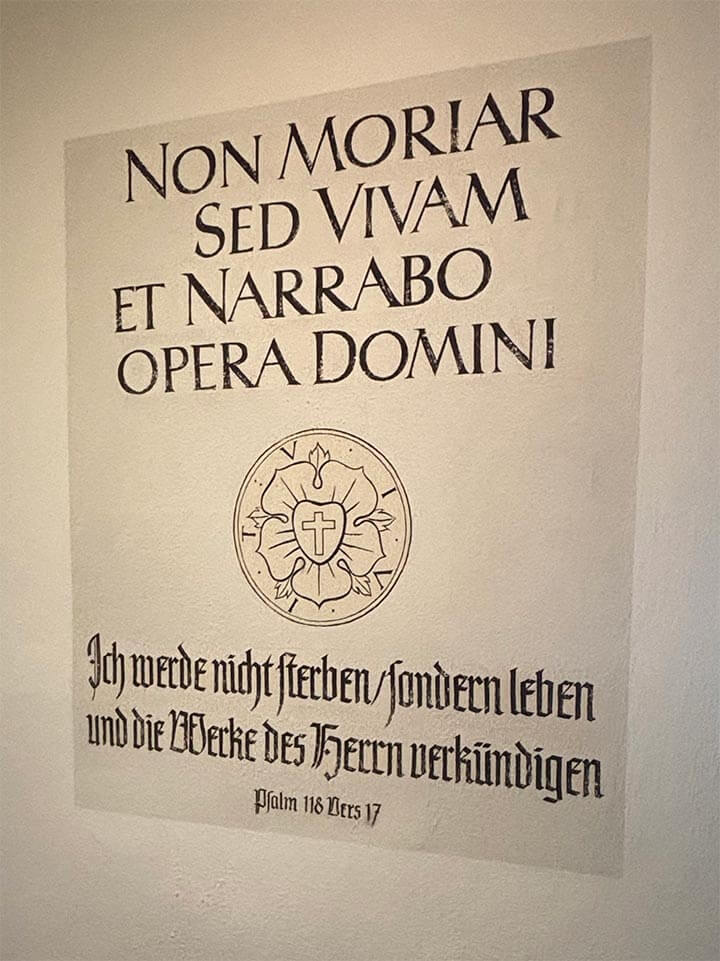
1 Corinthians 15 was one of Luther’s favorite parts of the New Testament. In 1532–1533, he preached 17 sermons in a row on it. Another of his favorite passages was Psalm 118:17 (“I shall not die, but I shall live and recount the deeds of the Lord”), which was written on the wall of his room in Coburg Castle during the Diet of Augsburg.
In a sermon on the first Sunday after Easter in 1523, Luther insisted that Jesus’s resurrection was not only a historical event (although it most certainly was historical): “It is not enough to believe that Christ has risen from the dead, because neither peace nor joy, power nor might follow, but [I must believe that] the resurrection happened for me, so that I delight that my own sin and death are overcome there. This is true faith.”
Guidance for Christian life
When we asked students to share something unexpected that stood out in Luther’s preaching, they observed that Luther was not afraid to give clear and concrete direction for Christian living. This should not have been a surprise, for the Lutheran Confessions are clear about the necessity of good works in the lives of those who are saved by grace through faith: “We openly confess, therefore, that the keeping of the law must begin in us and then increase more and more. And we include both simultaneously, namely, the inner spiritual impulses and the outward good works. Therefore the opponents’ claims are false when they charge that our people do not teach about good works since our people not only require them but also show how they can be done” (Apology of the Augsburg Confession IV.136).
In a sermon preached in Erfurt on his way to the Diet of Worms in 1521, Luther emphasized that good works have no power to save. But he also insisted that faith leads to a life of service toward others. “Do not perform good works in order to become godly; but if you are already godly, then do good works . . . Every person should so perform his work that it benefits not only himself alone, but also another, his neighbor. If he is rich, his wealth should benefit the poor. If he is poor, his service should benefit the rich. When persons are servants or maidservants, their work should benefit their master. Thus no one’s work should benefit him alone.” In a sermon on the Christian life in 1532, Luther makes clear that the Word and promise of God alone makes the heart pure. But out of a pure heart comes love toward others. “This love, however, should be a flowing love, which flows from the inside of the heart like a fresh stream that goes on flowing and cannot be stopped or dried up. This love says: I love you, not because you are good or bad; for I draw my love, not from your own goodness, as from another’s fountain, but from my own little spring, from the Word, which is grafted into my heart and bids me to love my neighbor. Then it flows out abundantly and is there for all who need it, touching both the good and the bad, friend and foe.”
Joys and Struggles in Preaching
Luther wasn’t always thrilled about his duty to preach. In a sermon on 2 Corinthians 3 in 1531, he called his role as preacher a “rotten office” and that he’d rather “be stretched upon a wheel or carry stones than preach one sermon.” But still, shortly after a particularly dark time, Luther declared: “If I could today become a king or emperor, I would not give up my office as preacher.”
For seminarians preparing to enter the office of preaching, and for professors who already occupy it, this class was a source of deep encouragement. Preaching is not light work. It demands much and its fruits aren’t always visible. Which is why we plan to offer the course again soon. As long as God continues sending preachers of the gospel to the ends of the earth, there is still much to learn from Luther as preacher of the Reformation.
Leave a Reply
You must be logged in to post a comment.